Observe
Run the parent on a training batch. Sample successful and failed trajectories.
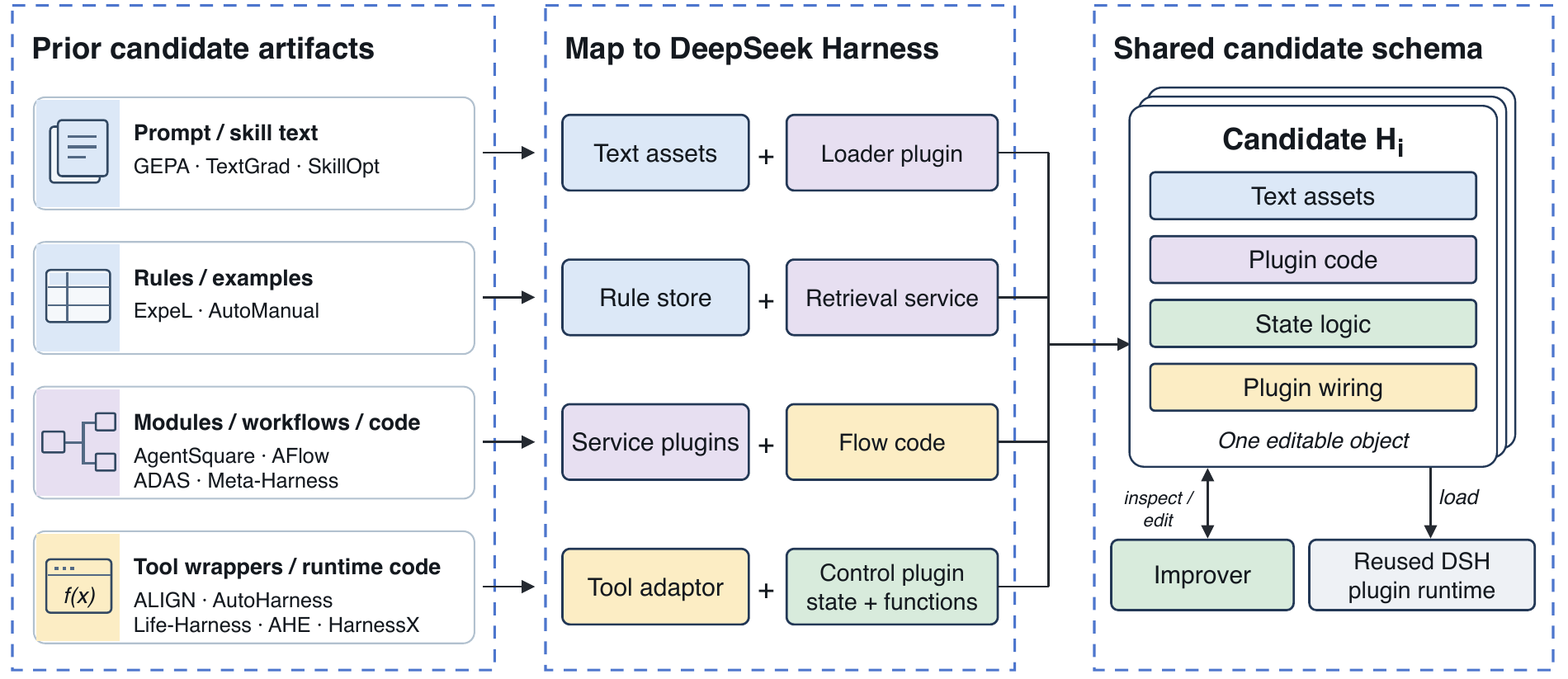
Coordinated plugin evolution for tool-using agents.
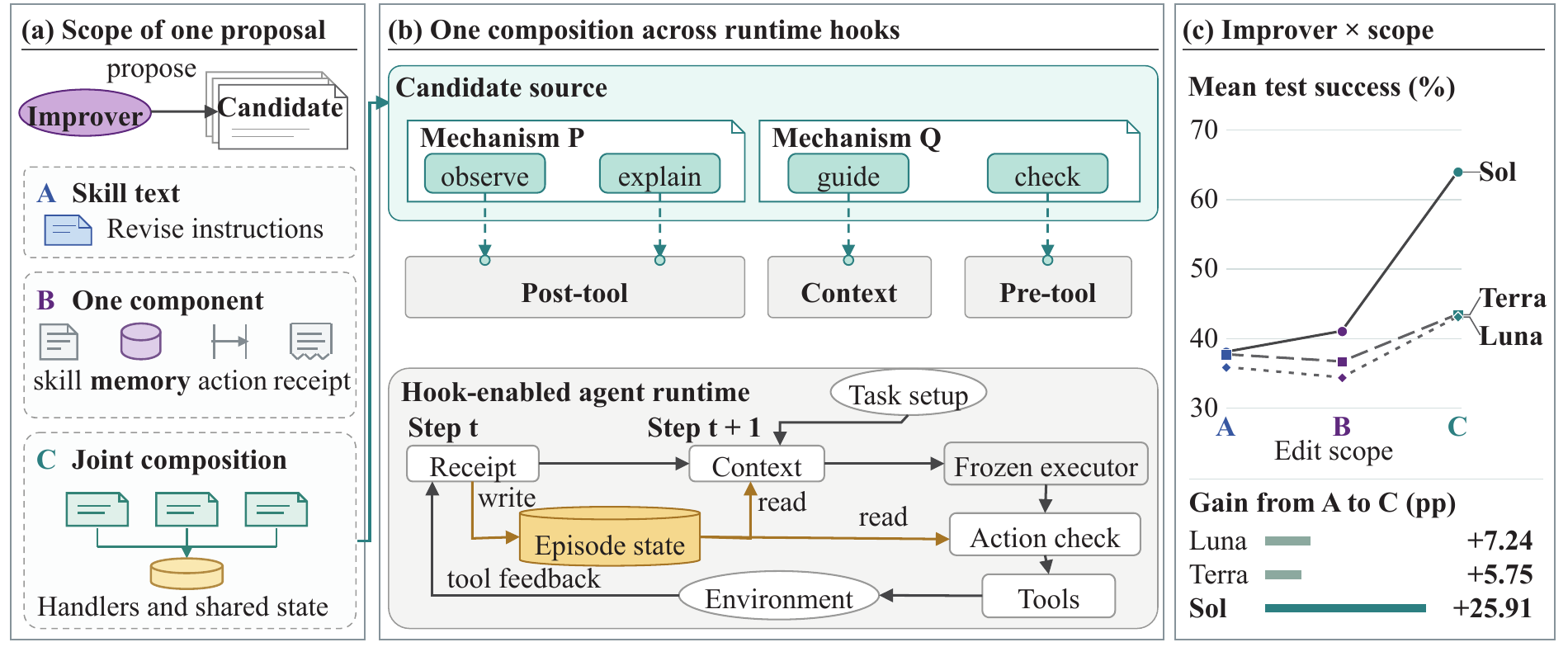
How does improver capability interact with the scope of a harness edit? We compare skill edits, independent components, and coordinated plugins around the same frozen executor.
ALFWorld / action-hint.mjs
A successful pickup updates the object held in episode state.
if (take) { held = take[1]; known.delete(held); }Core idea
HookEvo scales what an improver can change in a single proposal. At scope A it edits skill text. At B it can revise one independent component. At C it can change several handlers bound to different runtime hooks, together with the state they share within a task. That lets the improver propose a repair whose parts depend on one another and test their combined effect against the parent harness.
We held the Qwen3-4B executor fixed and compared Luna, Terra, and Sol at high reasoning effort across four benchmarks. With skill edits alone, Sol led the next improver by just 0.35 percentage points in mean test success. The lead grew to 4.37 points with independent component edits and 20.51 points with coordinated edits.
Moving from A to C raised Sol’s mean success from 38.04% to 63.95% (+25.91 points). Luna gained 7.24 points and Terra gained 5.75. The Sol scope C mean includes the OSBench narrow run with a different training set.
Compare all three improvers and edit scopes ↓ · Inspect the mechanisms they evolved ↓
Mean success gain for GPT-6.1 Sol from skill text to coordinated edits.
Benchmarks evaluated with frozen Qwen3-4B.
Improvers and edit scopes compared.
Main leaderboard
HookEvo achieves the highest held-out success among the Qwen3-4B-family methods in the table on all four benchmarks. Against our local Life-Harness rerun, the gains range from 4.86 percentage points on OSBench to 7.64 on ALFWorld.
| Method | ALFWorld | DBBench | WebShop | OSBench | Evaluation |
|---|---|---|---|---|---|
| HookEvo (Sol, scope C) | 95.41 ± 0.00 | 70.56 ± 0.38 | 48.17 ± 0.29 | 41.67 ± 1.84 | Local |
| Life-Harness (local) | 87.77 ± 1.91 | 64.11 ± 0.38 | 41.33 ± 0.29 | 36.81 ± 0.00 | Local |
| Life-Harness | 88.07 | 65.00 | 45.50 | 39.60 | Published |
| Bare | 16.51 | 44.00 | 29.50 | 21.50 | Published |
| ALIGN | 28.36 | — | 18.00 | — | Life-Harness |
| AgentSquare | 29.36 | — | 18.50 | — | Life-Harness |
| Meta-Harness (Life rerun) | 35.80 | 50.30 | 42.50 | 25.70 | Life-Harness |
| AHE (Life rerun) | 89.00 | 57.30 | 39.00 | 37.50 | Life-Harness |
| Harness-R1 (paper) | 29.10 | 55.70 | 38.60 | — | Published |
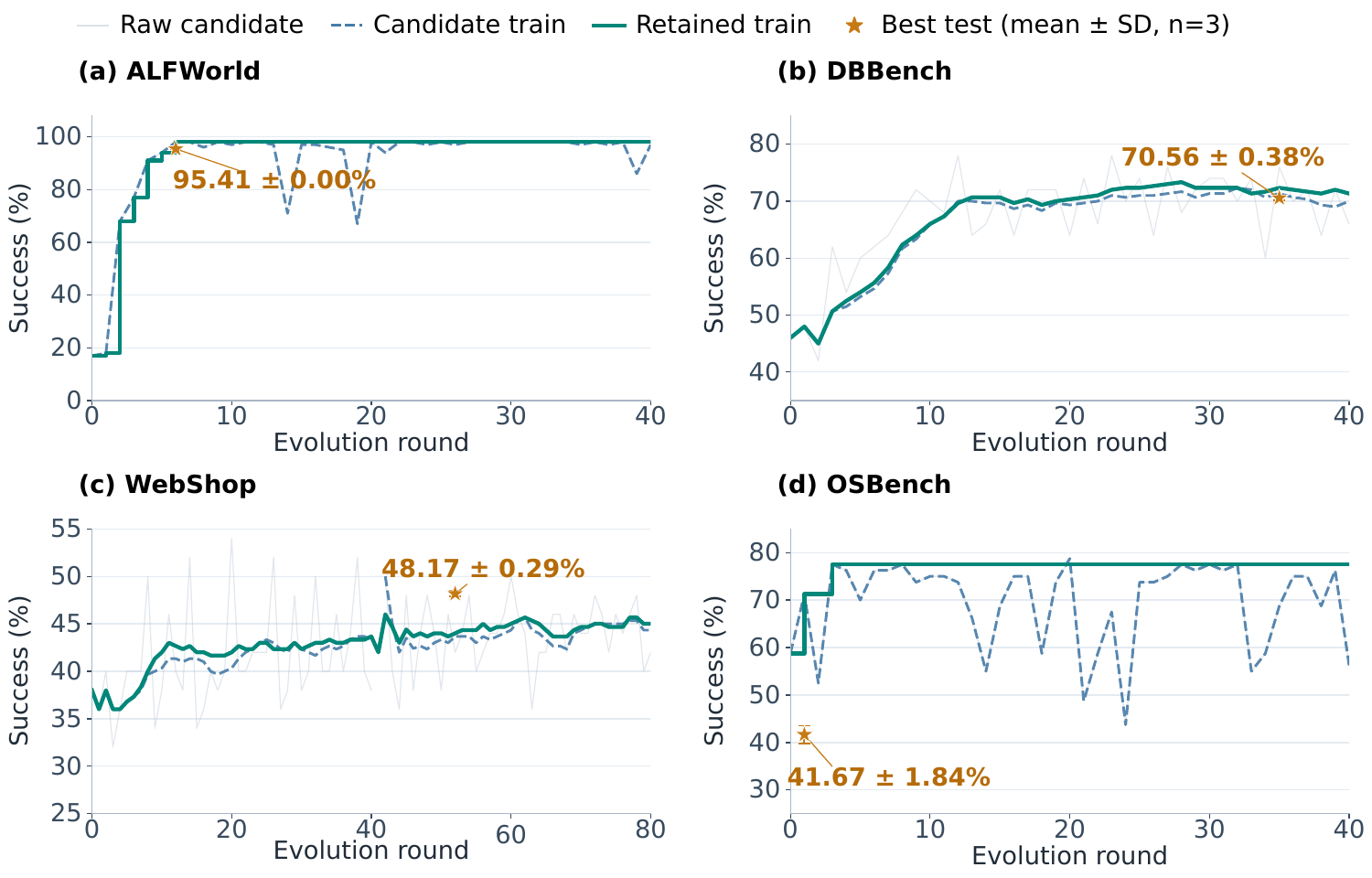
Later training rounds can overfit. For each benchmark, the leaderboard reports the checkpoint with the highest observed test success among those evaluated.
On OSBench, the standard A-sol61, B-sol61 and C-sol61 runs use the same 80 training tasks. Use those runs to compare edit scopes. The leaderboard entry (41.67 ± 1.84%) comes from C-sol61-narrow, whose 80 training tasks overlap the standard set by 9 IDs.
Local results show mean held-out success (%) ± sample SD over three executions. A dash indicates an unreported result. Life-Harness reports ALIGN and AgentSquare in Table 11 and its Meta-Harness and AHE reruns in Table 1. Harness-R1 specifies Qwen3-4B and uses 500 WebShop tasks; our evaluation uses 200. Life-Harness · Harness-R1
Held-out success (%). Local results include the sample standard deviation. Published results follow the task counts and protocols of their sources. A dash marks an unreported score.
| Executor | Method | ALFWorld | DBBench | WebShop | OSBench | Evaluation source |
|---|---|---|---|---|---|---|
| Qwen3-4B | HookEvo (Sol high) | 95.41 ± 0.00 | 70.56 ± 0.38 | 48.17 ± 0.29 | 41.67 ± 1.84 | Local |
| Qwen3-4B | ALIGN (released) | 3.36 ± 1.06 | — | 31.00 ± 0.50 | — | Local |
| Qwen3-4B | ReAct | 10.70 ± 1.06 | — | — | — | Local |
| Qwen3-4B | ReflAct | 18.35 ± 1.83 | — | — | — | Local |
| Qwen3-4B | AutoManual | 76.15 ± 1.59 | — | — | — | Local |
| Qwen3-4B | Harness-R1 patch | — | 52.22 ± 0.69 | — | — | Local |
| Qwen3-4B | Prompt-evolving† | 13.8 | 60.7 | 30.0 | 18.8 | Life-Harness |
| Qwen3-4B | SkillFM | 77.01 | — | 14.60 | — | SkillFM |
| Executor | Method | ALFWorld | DBBench | WebShop | OSBench | Evaluation source |
|---|---|---|---|---|---|---|
| Qwen2.5-14B | Life-Harness | 83.49 | 66.00 | 45.00 | 40.97 | Life-Harness |
| Qwen2.5-32B | Life-Harness | 92.66 | 69.33 | 46.50 | 45.83 | Life-Harness |
| Qwen2.5-72B | Life-Harness | 85.32 | 71.33 | 48.00 | 47.22 | Life-Harness |
| Llama-3.3-70B | Life-Harness | 92.66 | 68.67 | 44.00 | 39.58 | Life-Harness |
| Qwen3.6-27B | Life-Harness | 89.91 | 74.33 | 43.00 | 56.94 | Life-Harness |
| Qwen3.6-35B-A3B | Life-Harness | 89.91 | 71.33 | 45.00 | 54.17 | Life-Harness |
| Executor | Method | ALFWorld | DBBench | WebShop | OSBench | Evaluation source |
|---|---|---|---|---|---|---|
| GPT-5.5 high | Bare | 93.6 | 67.7 | 75.1 | 47.4 | Life-Harness |
| GPT-5.5 high | Life-Harness | 95.4 | 75.0 | 75.8 | 53.1 | Life-Harness |
| Opus 4.8 high | Bare | 97.2 | 71.7 | 73.8 | 50.4 | Life-Harness |
| Opus 4.8 high | Life-Harness | 98.1 | 74.3 | 82.7 | 50.8 | Life-Harness |
| Gemini 3.1 Pro | Bare | 96.3 | 76.5 | 67.3 | 50.0 | Life-Harness |
| Gemini 3.1 Pro | Life-Harness | 96.3 | 78.4 | 68.1 | 48.6 | Life-Harness |
| Executor | Method | ALFWorld | DBBench | WebShop | OSBench | Evaluation source |
|---|---|---|---|---|---|---|
| GPT-5.5 | TextGrad | 82.80 | — | — | — | TextGrad, SkillOpt |
| GPT-5.5 | GEPA | 85.80 | — | — | — | GEPA, SkillOpt |
| GPT-5.5 | SkillOpt | 95.50 | — | — | — | SkillOpt |
| GPT-4o | AgentSquare | 69.50 | — | — | — | AgentSquare |
| GPT-4o | ADAS | 54.30 | — | — | — | ADAS, AgentSquare |
| GPT-4o | ReflAct | 93.30 | — | — | — | ReflAct |
| GPT-4-turbo | AutoManual | 97.40 | — | — | — | AutoManual |
| GPT-3.5 series | AutoGuide | 79.10 | — | 46.00 | — | AutoGuide |
| PaLM-540B | ReAct | 57.00 | — | 40.00 | — | ReAct |
† Prompt-evolving scores are approximate readings from Life-Harness Figure 6. SkillFM uses its published task counts. Larger open-model and frontier-model results come from Life-Harness Tables 10 and 2.
Method
In ALFWorld, one handler records an accepted action in episode state. Other handlers use that state to guide the next prompt or check the next action. Evaluating those edits together lets their combined effect count toward selection.
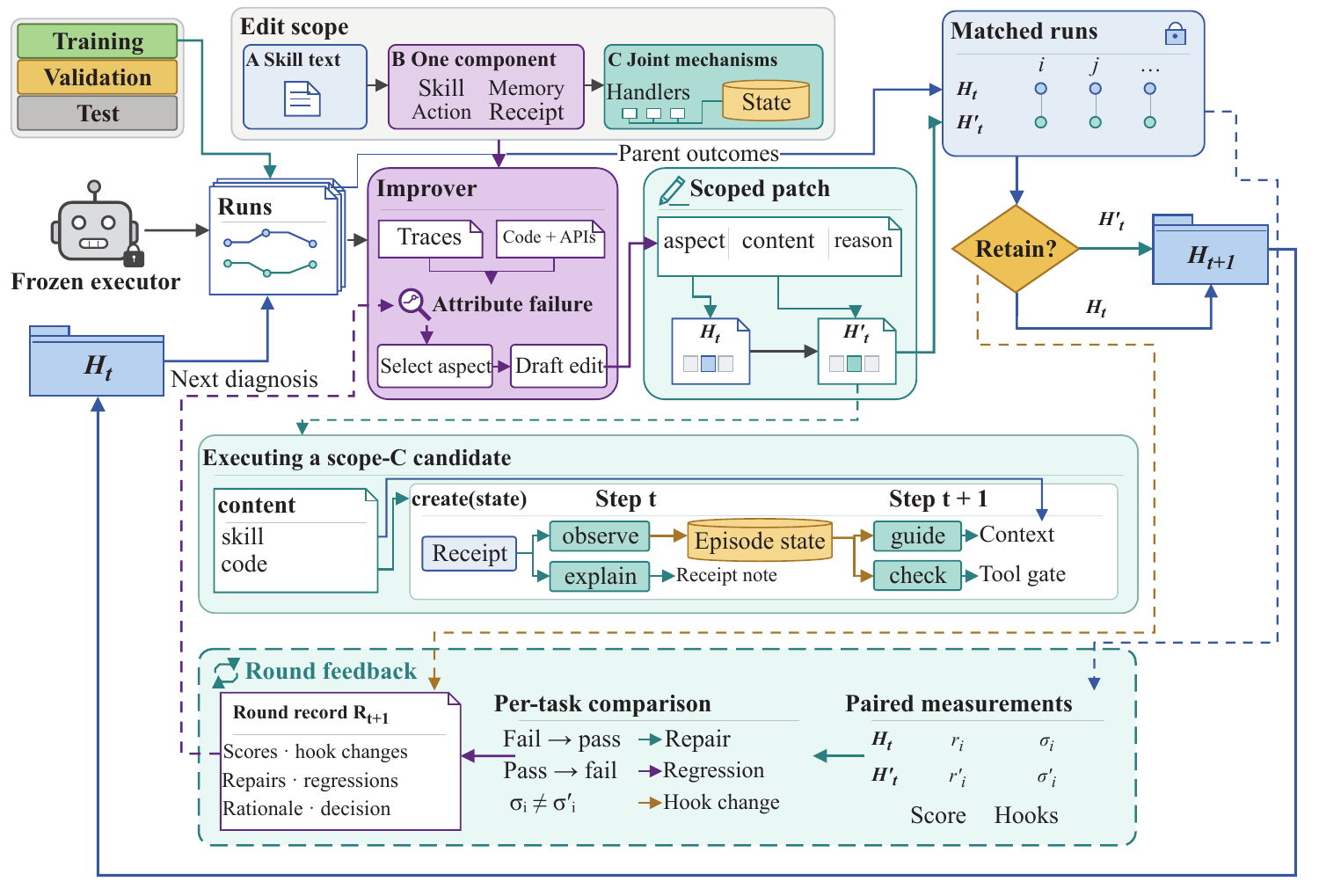
Run the parent on a training batch. Sample successful and failed trajectories.
The improver reads the parent source, runtime interfaces and prior feedback, then returns one scoped edit.
Pair parent and candidate by task, trial and seed. Measure score changes, repairs, regressions and hook outputs.
Require a training gain, a changed hook output and, where used, nondecreasing validation performance.
Held-out evaluation
The same frozen Qwen3-4B-Instruct-2507 executor runs each harness. Results show mean held-out success and sample standard deviation over three executions for the harness selected for each benchmark.
| Benchmark | Tasks | Success (%) | Source | Architecture |
|---|---|---|---|---|
| ALFWorld | 109 | 95.41 ± 0.00 | View harness ↗ | View figure |
| DBBench | 300 | 70.56 ± 0.38 | View harness ↗ | View figure |
| WebShop | 200 | 48.17 ± 0.29 | View harness ↗ | View figure |
| OSBench | 144 | 41.67 ± 1.84 | 80 training task IDs ↗ | — |
Released harnesses
ALFWorld
After the environment accepts an action, the action-hint plugin records what changed. Context assembly and the pre-execution guard can then act on the same episode state.
Read the implementation ↗Inspect the evaluation ↗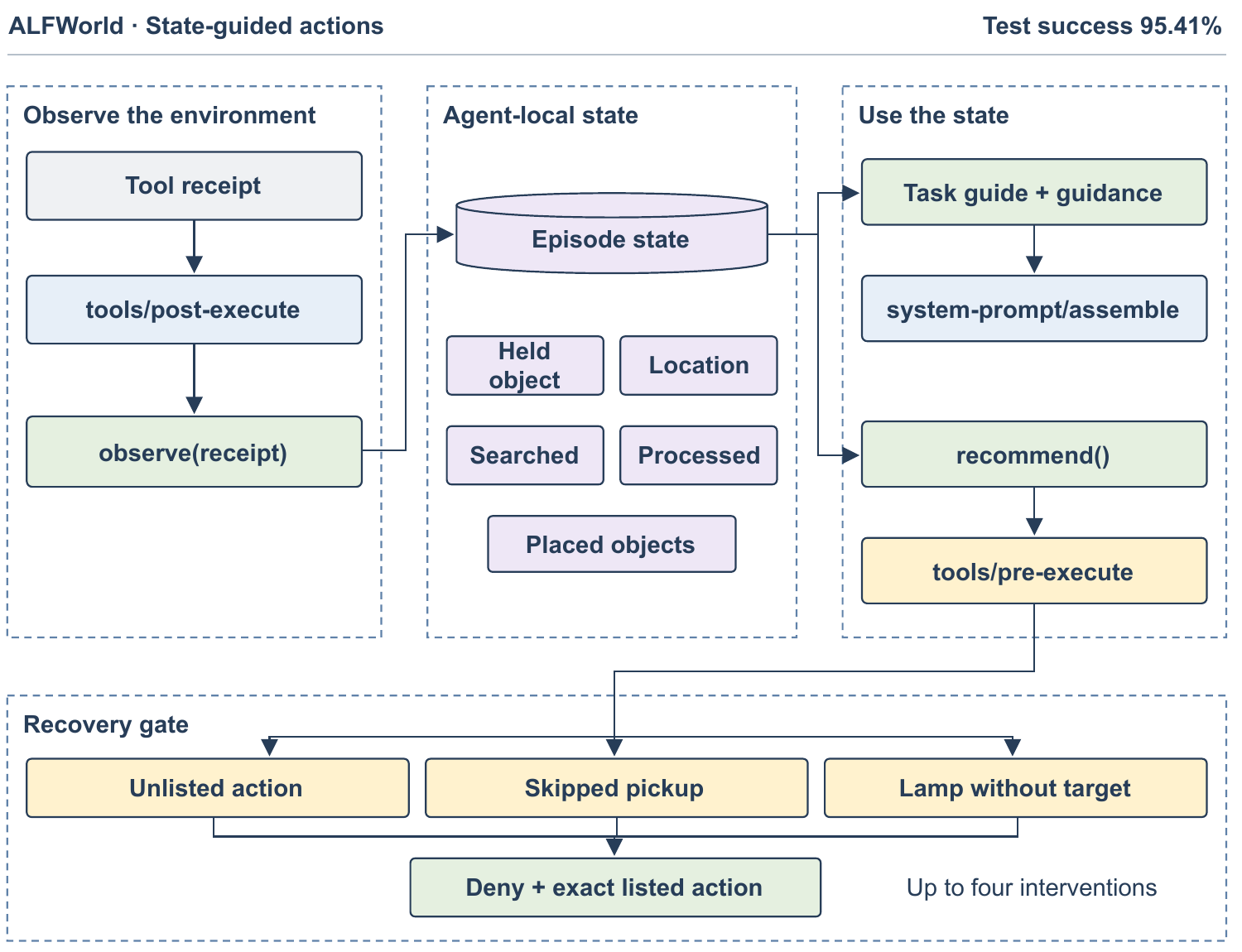
DBBench
The result bridge parses SQL receipts into arguments for the final answer. A separate write-workflow plugin tracks database changes across calls.
Read the implementation ↗Inspect the evaluation ↗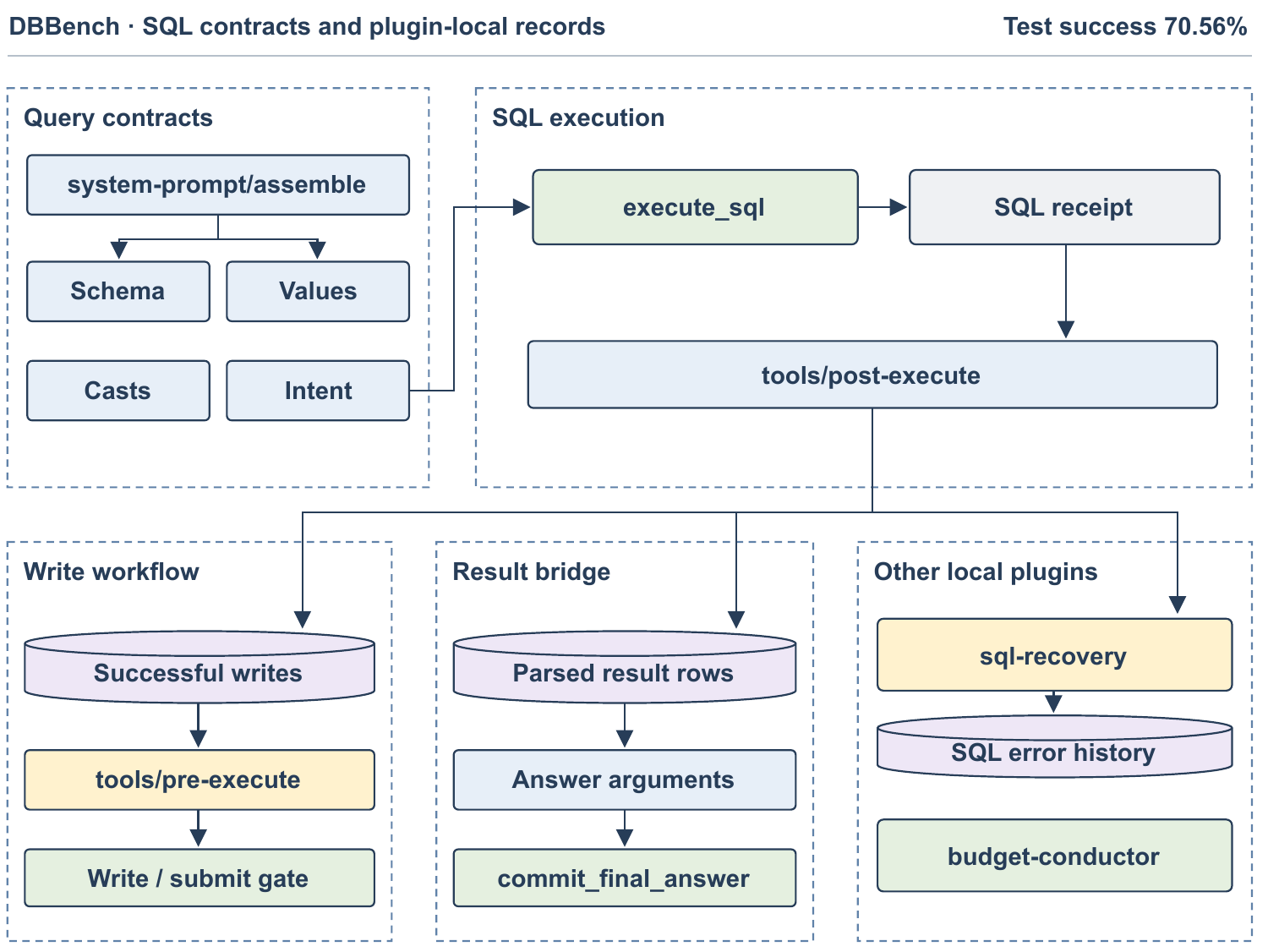
WebShop
The option ledger tracks visible option evidence as the agent moves through a product page. The checkpoint also includes search-evidence and the helper modules used by both plugins.
Read the implementation ↗Inspect the evaluation ↗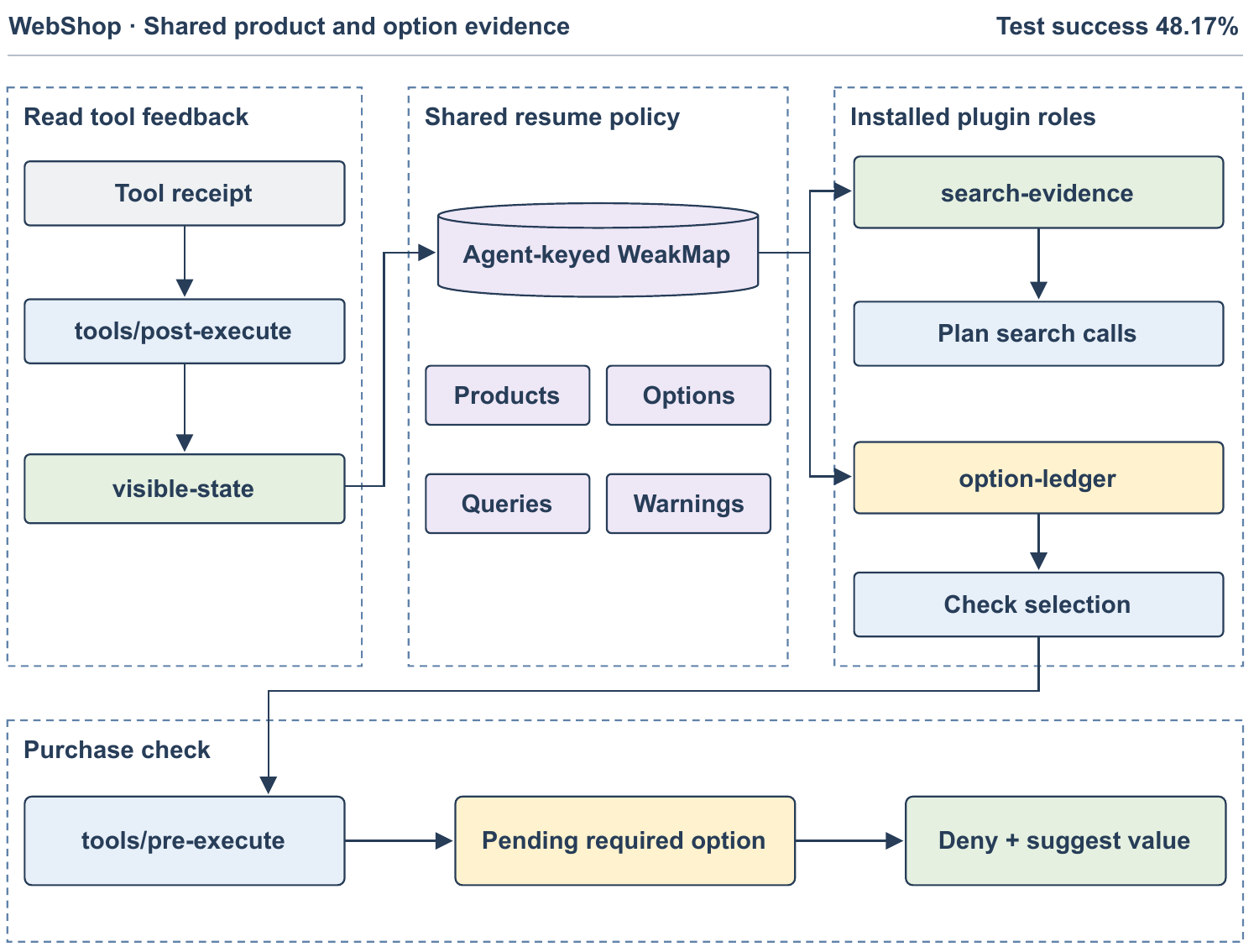
Section 4.2 · Edit scope
Each cell is mean test success (%) across the four benchmarks. The published Sol scope C mean includes the OSBench narrow run, which uses a different training set. Scope A changes skill text, B replaces one independent component, and C permits coordinated edits to handlers and shared state.
| Improver | A · Skill | B · Component | C · Coordinated | C − A |
|---|---|---|---|---|
| GPT-6 Luna | 35.86 | 34.36 | 43.10 | +7.24 pp |
| GPT-6.1 Terra | 37.69 | 36.66 | 43.44 | +5.75 pp |
| GPT-6.1 Sol | 38.04 | 41.03 | 63.95 | +25.91 pp |
| Improver | Scope | ALFWorld | DBBench | WebShop | OSBench | Mean |
|---|---|---|---|---|---|---|
| GPT-6 Luna | A | 23.85 | 53.00 | 32.33 | 34.26 | 35.86 |
| GPT-6 Luna | B | 14.07 | 54.56 | 31.33 | 37.50 | 34.36 |
| GPT-6 Luna | C | 48.62 | 57.00 | 30.67 | 36.11 | 43.10 |
| GPT-6.1 Terra | A | 26.91 | 53.78 | 30.50 | 39.58 | 37.69 |
| GPT-6.1 Terra | B | 29.97 | 53.78 | 29.33 | 33.56 | 36.66 |
| GPT-6.1 Terra | C | 52.91 | 54.00 | 32.83 | 34.03 | 43.44 |
| GPT-6.1 Sol | A | 27.22 | 52.89 | 34.33 | 37.73 | 38.04 |
| GPT-6.1 Sol | B | 33.33 | 53.56 | 37.67 | 39.58 | 41.03 |
| GPT-6.1 Sol | C | 95.41 | 70.56 | 48.17 | 41.67 | 63.95 |
The mean weights the four benchmarks equally. Luna and Terra each use one execution for scope C on DBBench and OSBench.
Section 4.3
Gains are percentage points over the bare Qwen3-4B executor on the same benchmark.
| Benchmark | Improver | Gain (pp) | Selected mechanism |
|---|---|---|---|
| ALFWorld | GPT-6 Luna | +32.11 | Training traces show receipt reminders and wrong-object checks. |
| ALFWorld | GPT-6.1 Terra | +36.40 | Training traces show pickup guidance and a target check in two-object tasks. |
| ALFWorld | GPT-6.1 Sol | +78.90 | Inventory and search history tell the action check when to require a pickup or stop a repeated search. |
| DBBench | GPT-6 Luna | +13.00 | An empty read can hold up submission until the agent checks the result. |
| DBBench | GPT-6.1 Terra | +10.00 | A SQL skill tells the agent how to quote identifiers. |
| DBBench | GPT-6.1 Sol | +26.56 | A log of successful writes guards two decisions: whether to repeat a write and whether to submit. |
| WebShop | GPT-6 Luna | +1.17 | A checklist prompts the agent to inspect options and price. |
| WebShop | GPT-6.1 Terra | +3.33 | A search skill preserves model numbers and sizes across queries. |
| WebShop | GPT-6.1 Sol | +18.67 | Search and option plugins share product state. Checkout can be blocked until a required option is selected. |
| OSBench | GPT-6 Luna | +14.61 | A counting skill distinguishes files from matching lines. |
| OSBench | GPT-6.1 Terra | +12.53 | A command check flags misleading pipelines. Receipt annotations explain the output. |
Each gain compares selected harnesses from separate searches. WebShop C used a continued search.
| Benchmark | Scope change | Gain (pp) | Change in mechanism |
|---|---|---|---|
| ALFWorld | A → B | +6.12 | Target-tracking instructions gain inventory updates from tool receipts. |
| ALFWorld | B → C | +62.08 | The action check goes beyond call format: it reads inventory and can block departure before pickup. |
| DBBench | A → B | +0.67 | SQL naming guidance is supplemented by repair suggestions after a query fails. |
| DBBench | B → C | +17.00 | A log of successful writes lets the harness block duplicate writes or early submission. |
| WebShop | A → B | +3.33 | The option checklist gains page feedback that highlights matching choices. |
| WebShop | B → C | +10.50 | Search and checkout share option state, so a missing selection can block purchase. |
| OSBench | A → B | +1.85 | A receipt annotation tells the agent whether its command counted files or lines. |
Reproduction
From a fresh checkout, run the synthetic A/B/C check with Python 3.10–3.12 and Node.js 22.19+ with npm. It exercises the real plugin runtime using a scripted actor.
python3 -m venv .venv
source .venv/bin/activate
python -m pip install -e evolution
python evolution/scripts/smoke.py ./runs/smoke
The reproduction guide lists the external assets and model access for each benchmark. Choose a frozen profile to evaluate a released checkpoint, or an A/B/C profile to run a new search.
Reference
Cite the HookEvo paper using the arXiv record. The code and benchmark artifacts have a separate software citation.
@misc{huang2026hookevoframeworkcoordinatedplugin,
      title={HookEvo: A Framework for Coordinated Plugin Evolution on Hook-Enabled Agent Runtimes},
      author={Shengze Huang and Yanyu Mao and Xiaofei Yu and Baoshen Guo and Xiaorui Wang and Zhiwen Wu and Sheng Wu and Fukang Wen and Chengxu Wu and Linhao Li and Kailai Sun and Baotong Mi},
      year={2026},
      eprint={2611.27294},
      archivePrefix={arXiv},
      primaryClass={cs.AI},
      url={https://arxiv.org/abs/2611.27294},
}